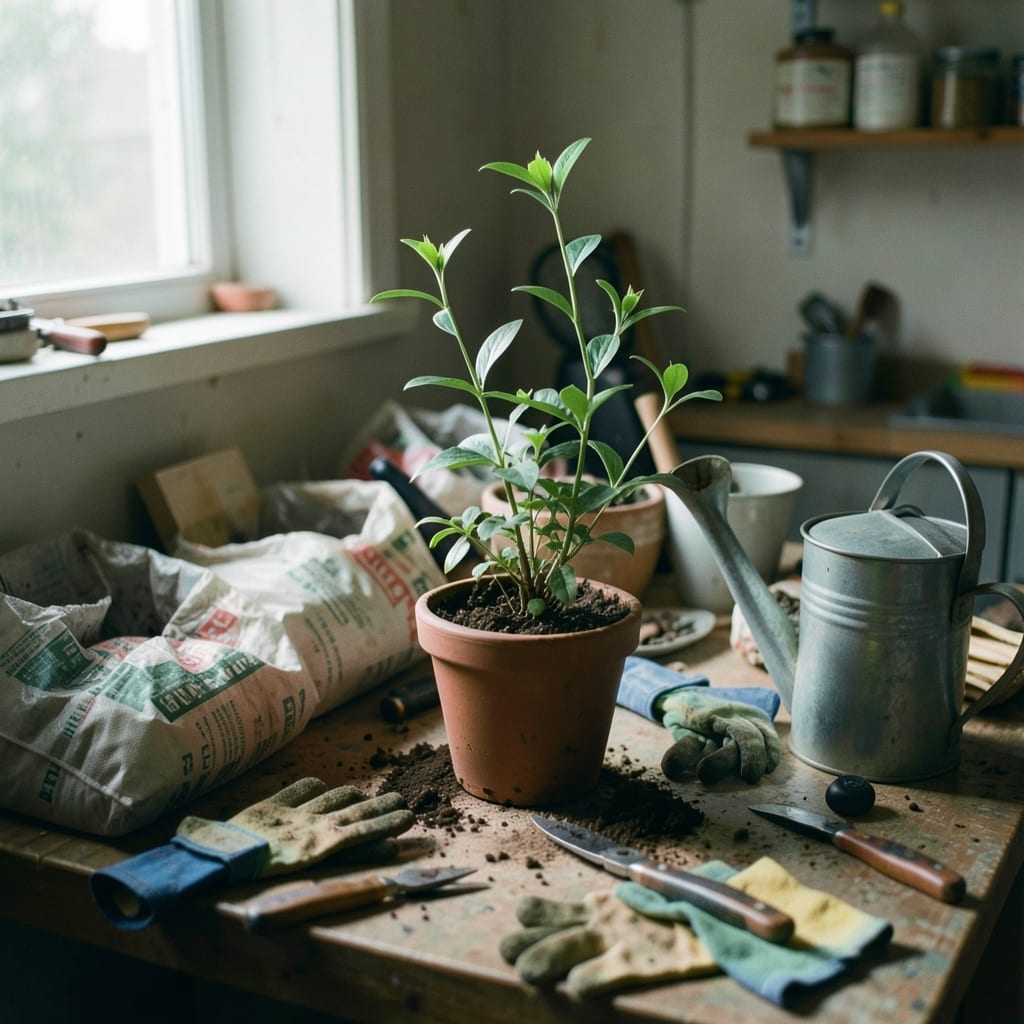
Why I started Bush Border Guide
I was twenty-four, kneeling in my grandfather’s old garden in upstate New York, trying to coax life from a tray of tomato seeds.
The soil was too dry, the light too weak, and every seedling that did push through the dirt leaned toward the window like it knew something I didn’t. By the third week, half had collapsed.
My grandfather, watching from the porch, just shook his head and said, *‘You’re trying to grow tomatoes like they’re in a greenhouse.
They’re tougher than that.’* I didn’t believe him—until I tried again, this time with the right soil, the right light, and the patience to wait for the roots to find their footing.
That’s when I realized most gardening advice treats plants like they’re all the same. They’re not. A tomato seedling needs different care than a fern cutting, and a fern cutting needs different care than a stubborn rose bush that refuses to bloom.
This site is for the people who’ve spent hours digging, pruning, and waiting—only to wonder if they’re doing it wrong.
Here, you’ll find the lessons I’ve learned the hard way: which plants lie about their needs, how to tell when you’ve overwatered (or underwatered), and why some seeds just refuse to play by the rules. No fluff, no guesswork—just what actually works, in real dirt, under real skies.
Meet the founder

My first garden was a 4x4-foot plot in my grandfather’s backyard, where I spent my summers convinced I was either a botanist or a murderer—depending on whether the beans were thriving or wilting.
He’d hand me a trowel and say, *‘Dig like you mean it,’* then walk away to let me figure out the rest.
Most of what I learned came from watching what *didn’t* work: the marigolds that bolted in the heat, the basil that turned bitter before it even flowered, the zucchini vines that took over the entire yard like an uninvited guest.
His only rule? *‘If it’s not growing, ask yourself: Am I giving it what it wants, or what I think it wants?’*
The one tool I still own from those days is a rusted hand pruner with a broken spring—it’s been duct-taped together at least three times, and the blade is so dull it takes three cuts to sever a stem.
I keep it on my windowsill because it’s the only thing that’s survived longer than my own attention span.
It’s seen me overwater ferns until their roots rotted, under-prune roses until they bled sap, and once try to grow mint from a grocery store bunch that had already sprouted roots in the plastic clamshell. (Spoiler: It did not end well.)
The failure that changed everything was the year I tried to grow peppers from seed indoors. I followed every ‘expert’ advice: warm soil, bright light, thin seedlings. But my jalapeños? They stretched into leggy, sad stalks that collapsed the second I set them outside.
Turns out, they needed *less* light, not more—and the ‘warm soil’ trick was a myth. That year, I stopped trusting seed packets and started trusting my own dirt. Now, I test everything twice: once in my backyard, once in a friend’s shade garden, once in a pot on a balcony.
If it doesn’t work in all three, it’s not getting a profile here.
I still have the habit of talking to my plants.
Not the dramatic, *‘Grow for me, my green friend’* kind of way—just a running commentary on what’s going wrong. *‘Why are your leaves curling, you little traitor?’* or *‘I swear I gave you enough water.’* My neighbors think I’m nuts, but it works.
Plants respond to consistency, and if I’m muttering at them, I’m also paying attention. The only thing that’s stopped me is my cat, who hisses at me when I scold the pothos for dropping leaves. (She’s right—it was the draft.)
Meet the mascot

The mascot started as a scribble on a napkin during a rain delay at a community garden workday. I was sketching what I thought a ‘garden fairy’ would look like—something between a toad and a weed, with oversized hands and a dirt-smudged face.
The first draft had six fingers, a flower for a hat, and a tail that curled like a dandelion gone to seed. My friend Maria laughed and said, *‘That’s not a fairy, that’s a very confused gardener.’* She was right.
So I redrew it: same stubby legs, but now holding a trowel instead of a wand, with a seedling sprouting from its palm like it had just pulled it out of the ground.
The proper drawn version ended up on a coffee-stained notepad, where I tried to simplify the chaos. The fairy-toad hybrid became a squat, round figure with a broad-brimmed hat to shield its face from sun and rain.
The tail shrank to a single, gnarled vine, and the extra fingers disappeared—too many lines made it look like a child’s drawing.
The seedling in its hand grew longer, with two true leaves instead of one, because I’d just pulled up a real basil cutting that morning and it had exactly two leaves. The hat’s brim got a jagged edge, like it had been chewed on by a real gardener.
For the final version, I had to kill almost everything. The hat’s flower disappeared—too delicate at this size—and the vine tail became just a bump at the hip. The trowel turned into a single, thick line, and the seedling’s stem was reduced to a single curve.
The face lost its eyes (they were just smudges anyway) and gained a permanent frown, because no gardener looks happy all the time.
I named it *Muck*—short for *‘muddy hands and no regrets.’* It’s supposed to look like the kind of creature that would dig up your prize tomatoes just to see what’s underneath, then pat the dirt back down like it’s sorry. (It’s not.)
What I promise you
This site isn’t about perfect gardens or flawless plants. It’s about the mess in between—the overcrowded seed trays, the half-dead cuttings you propagate anyway, and the years it takes to figure out what your soil actually needs. What you can hold me to is this:
What you can hold me to
- Every plant profile includes *exactly* what I did, what went wrong, and how I fixed it—no ‘best practices’ without the ‘worst failures.’
- If I say ‘water deeply,’ I mean *until water runs out the bottom of the pot.* If I say ‘full sun,’ I mean *six hours of direct light, not ‘as much as possible.’*
- I update old posts when new mistakes teach new lessons. (Example: My first ‘how to grow herbs’ guide didn’t mention that mint is a bully. Now it does.)
- The mascot, Muck, is here to judge you. (Kidding. Mostly.)
How I create a plant profile
A profile starts in the dirt—not on a seed packet or a gardening forum, but in the actual conditions where the plant will live. If I’m writing about growing tomatoes in a pot, I don’t test them in a greenhouse first.
I start with the pot, the soil, and the sunlight I’ve got, because that’s what matters. The first draft is always a list of *what happened*, not *what should happen*: *‘Day 1: Planted seeds. Day 3: Nothing. Day 5: Mold.
Day 7: Pulled them out and tried again with perlite.’* No pretty photos, no aspirational language—just the truth, even if it’s embarrassing.
The first stage: watching like a hawk
The first three weeks are all about *not touching anything*. If you’re starting seeds, that means no peeking under the dome, no adjusting the light unless it’s clearly failing, and absolutely no watering on a schedule—plants tell you when they’re thirsty, but you have to learn their language.
I check soil moisture by lifting the pot: if it’s light, it’s dry. If it’s heavy, it’s soggy. (And if it’s somewhere in between, you’re doing it right.) Temperature matters more than you think: too cold, and seeds rot; too hot, and they bolt before they sprout.
I use a cheap soil thermometer, but if you don’t have one, stick your finger in the dirt. If it’s warmer than your wrist, it’s too hot.
The first sign something’s wrong is usually the leaves. Yellowing? Overwatered or nutrient-deficient. Wilting in the morning? Underwatered. Brown edges?
Too much salt or fluoride in your tap water. (Yes, that’s a real thing.) I keep a notebook by my workbench with sketches of what ‘normal’ looks like for each plant, so I can spot trouble early. And if the problem isn’t obvious? I wait another day.
Plants don’t fail overnight—they fail because you ignored the small signs. Patience is the hardest part.
The second stage: fixing without guessing
Once you’ve identified the problem, the fix is usually the opposite of what you’d expect. Overwatered? Stop watering and let the soil dry out completely before trying again. Underwatered? Soak the roots, then let excess water drain away—don’t just give it a sip. Nutrient-deficient?
I mix in compost tea or a diluted fish emulsion, but only after testing the soil pH. (A cheap kit from the garden center does the job.) The key is to change *one thing at a time*.
If you adjust water, light, and fertilizer all at once, you’ll never know what actually worked.
Some problems take longer to solve. Fungal issues, for example, often mean you’ve got too much humidity or poor airflow. I’ve had to move entire trays of seedlings into a brighter spot just to dry them out, even if it meant sacrificing the ‘perfect’ light conditions.
And if a plant is beyond saving? I pull it up, examine the roots, and write down what killed it. That’s the real lesson: the next time you plant that species, you’ll know what to avoid. Gardening isn’t about winning—it’s about learning which battles aren’t worth fighting.
How a page gets onto this site
The first draft is always written while the plant is still alive—sometimes even while I’m pruning it.
I jot notes on a waterproof pad: *‘Third leaf set—time to pinch back,’* or *‘Soil smells like vinegar—time to repot.’* Then I transcribe it all into a rough draft, but I don’t publish anything until the plant has either thrived or died. (Yes, I’ve written profiles about dead plants.
Their lessons are just as valuable.) The second read is where the cutting happens: I remove every sentence that says *‘should’* or *‘might.’* If it’s not a hard rule or a real failure, it goes.
Pages get rewritten when new mistakes happen. My ‘how to grow peppers’ guide started as a single post, but after three years of trial and error—including a batch of jalapeños that turned into tiny, bitter nubs—I split it into two: one for container growing, one for in-ground.
The ‘troubleshooting’ section tripled in size. And if a method works for six months but then fails? I update the post with a note: *‘This worked until the soil pH dropped. Now try adding lime.’* Gardening isn’t static, and neither should this site be.
Write to me
I love hearing about the plants you’ve killed, the ones you’ve saved, and the ones that refuse to behave. Send me photos of your weirdest garden failures—I’ve got a whole shelf dedicated to mine. (The ‘mystery vine’ that turned out to be bindweed?
Iconic.) If you’ve got a plant that’s stumping you, describe the problem and I’ll tell you what I’d try next. And if you just want to vent about seed packets that lie, I’m here for that too.
You’ll find me on the contact page, where you can ask questions, share your own disasters, or just tell me about the time your tomato plant outgrew your trellis and started shading your neighbor’s yard. (True story. They sent me a thank-you note.)
Thanks for growing with me—even when it’s messy.
Joelle
The guides are grouped by category: Advice, Aphids, Blooming, Companion Plants, Container Gardens and Flowers.