
Plants
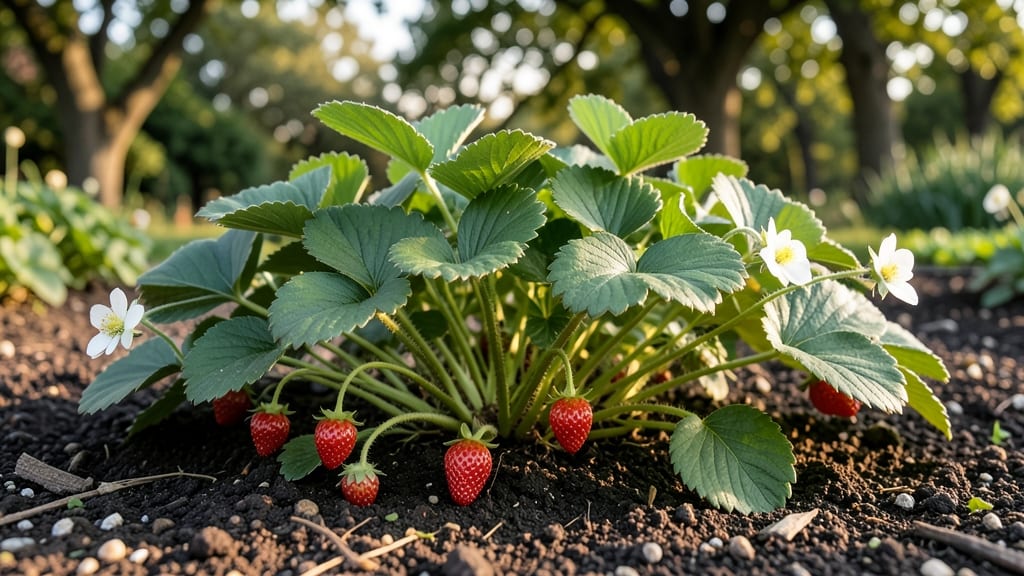
A strawberry bush looks like a low-growing plant with glossy, three-lobed leaves featuring jagged edges and vibrant green stems that sprawl across the ground. It blooms with delicate white flowers that develop into the classic heart-shaped red berries we know, while its long, trailing runners help it spread into lush ground cover over time.
A strawberry bush's most distinctive feature is its trifoliate leaves—each leaf has three oval-shaped sections with sharp, saw-like edges that catch light beautifully. 🌿 The stems grow close to the ground, often forming dense mats through their creeping habit, while the small white flowers (about ½ inch wide) appear in clusters before transforming into the bright red berries.
What sets it apart from other plants is how the runners—thin, wiry stems—spread outward to create new plants, making identification straightforward once you know what to look for.
These plants thrive in sunny spots and often reach 6-12 inches tall, though some varieties stay even lower. The berries themselves are the giveaway—no other common garden plant produces those signature heart-shaped fruits in such vibrant red hues.
If you see a plant with similar leaves but no runners or berries, it might be a different variety or even a lookalike like wild strawberry plants, which stay much smaller and produce tiny fruits.
💡 In This Article
- Identifying Strawberry Plant Leaves, Stems, and Flowers
- Visual Differences Between Strawberry Varieties and Common Lookalikes
Identifying strawberry plant leaves, stems, and flowers
The trifoliate leaves of a strawberry plant are its most distinctive feature, with each leaf composed of three oval-shaped leaflets arranged in a fan-like pattern. These leaflets typically measure 1-3 inches long and have serrated edges that create a jagged outline, almost like a saw blade under magnification.
The surface is glossy and smooth to the touch, reflecting light in a way that makes them stand out against duller foliage. 🌿 This glossy texture helps repel water, reducing fungal diseases that commonly affect other ground covers.
The stems, or stolons, of a strawberry plant grow horizontally along the ground, often forming a dense mat over time. These stems have a triangular cross-section when viewed in profile, which distinguishes them from rounder stems of other plants.
What's truly unique is how these stems produce new plantlets at their tips, connected by thin, wiry runners that can stretch up to 2 feet long. These runners root where they touch the soil, creating a self-propagating ground cover that's both efficient and visually striking.
When strawberry plants flower, they produce small white blossoms with five delicate petals that spread outward like a star. Each flower sits atop a slender stem and contains 20-30 yellow stamens that release pollen, making them a favorite for pollinators like bees.
The flowers appear in clusters, often emerging in spring before transforming into the iconic heart-shaped berries. What many gardeners don't realize is that these flowers can be affected by temperature—cold snaps below 50°F can damage them, reducing fruit production later in the season.
One key detail that helps distinguish strawberry plants from lookalikes is the arrangement of these flowers and leaves. The leaves grow alternately along the stem, while the flowers emerge from leaf axils (the angle between the leaf and stem).
This specific growth pattern, combined with the runners, creates a distinctive "bushy" appearance that spreads outward rather than upward. The runners themselves are often mistaken for vines, but they lack tendrils or climbing structures, remaining firmly rooted to the ground.
Finally, the fruit itself provides a clear identification clue. Strawberries develop from the receptacle (the swollen base of the flower), which is why the "fruit" we eat is actually a composite structure with tiny seeds embedded in its surface.
This unique botanical feature sets strawberries apart from other berries, which typically develop from a single ovary. The heart shape of the fruit is another dead giveaway—no other common garden plant produces berries with this distinctive silhouette.
Understanding these visual cues makes it easier to spot strawberry plants in gardens or wild settings. The combination of trifoliate leaves, horizontal runners, and heart-shaped fruits creates a signature look that's hard to confuse with other plants.
For gardeners, recognizing these features early can help manage growth and maximize fruit production. 🌱